


wave theory
2026-11-16 17:16|30 views
Wave theory is a technical analysis that can analyze financial market cycles and predict market trends, which was proposed by Eliot in 1930. By fully studying the relevant information of financial markets, we can find the law of price fluctuation, which will follow a series of specific patterns and form a tool to analyze price fluctuation.
Basic features
(1) The rise and fall of the price index will alternate;
(2) The push wave and the adjustment wave are the two most basic types of price fluctuation, while the push wave (I .e. the wave in line with the market trend) can be divided into five small waves, which are generally represented by the first wave, the second wave, the third wave, the fourth wave and the fifth wave. The adjustment wave can also be divided into three small waves, which are usually represented by the wave, the B wave and the C wave.
(3) After the above eight waves (five up and three down) are completed, one cycle is completed and the trend will enter the next eight wave cycle;
(4) The length of time will not change the shape of the wave, because the market will still develop according to its basic pattern. Waves can stretch or shrink, but their basic patterns remain unchanged.
In short, the wave theory can be summed up in one sentence: the "eight wave cycle"
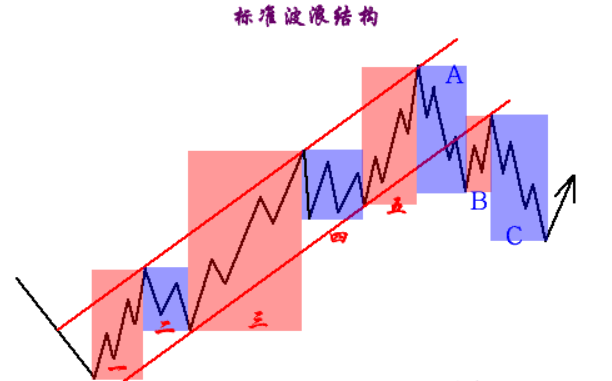
Key parts
Investors should understand Elliott's wave theory, the key of which consists of three main parts:
the first is the wave form;
the second is the proportional relationship between waves;
the third is the time spacing between waves.
The shape of the wave between these three is the most important. The pattern of waves is the theoretical basis of Elliott's wave theory, so the correctness of wave counting is crucial to the successful use of wave theory for investment timing. Wave theory does not exist independently he has some magical associations with Dow theory, technical analysis, economic fundamental analysis, and news value types. Many investors said: "Dow theory tells people what the sea is and wave theory tells you how to surf on the sea.
Three principles of wave
modified wave depth principle
used to measure the magnitude of the correction wave retracement, usually the correction wave will reach near the low point of the small one-level 4 wave. In a strong market, only new highs are not new lows. At this time, the small one-level 4-wave low will be a good support level, which can be used to follow up the stop loss.
golden section principle
that is, the volatility ratio presents the golden ratio. For example: 3 waves for 1 wave of 1.618, 2.618...; 2 waves for 1 wave of 0.382, 0.5, 0.618;4 waves for 3 waves of 0.382, 0.5;5 waves for 1~3 waves of 0.618. The same principle is presented in time.
1. The golden ratio can not only help us achieve a good entry, but also a good appearance. If you can integrate with the market, these mysterious golden numbers will become your lifelong companion.
2.1.618 can, in turn, determine whether the three waves in front of us are the real three waves. If the three waves cannot even reach the 1.618 of one wave, then it is probably not the three waves. If you can judge that the market is going to have an extended big market, then the market will usually go to 2.618 times the position of the previous wave, giving a very good reference target.
3, in the early stage of the trend, the retracement is mostly 0.618, if the retracement is carried out in a platform shape, it is mostly 0.5; in the middle of the trend, when the trend is gradually obvious, the probability of the market retracement 0.618 begins to decline, but the expectation is biased towards the 0.5 retracement;
principle of alternation
that is, simple and complex, up and down, push and adjust, regular and irregular. Correction waves show alternating phenomenon, such as 2 waves are sawtooth, 4 waves may be platform or triangular, etc., and vice versa. If wave 2 is "double-entry", wave 4 may be "single-entry".
1, small adjustment matches the small push, medium adjustment also indicates the medium drive, large adjustment is in the accumulation of a wave of large push market, in front of a small level of adjustment is to do a small push operation plan, in front of a large level of adjustment is to do a big push operation plan.
2. If there is a simple adjustment in the 2 waves, the 4 waves are mostly complicated adjustments. If the adjustment time of the 2 waves is very short, it can be basically judged that the adjustment time of the 4 waves will not be very short, and the known ones can be used to predict the upcoming ones, thus improving the operation odds. If wave 2 goes out of a very regular form, it should be noted that wave 4 can go out of a less regular form.
Defects
(1) Wave theorists do not have a uniform view of the phenomenon. Every wave theorist, including Eliot himself, is often troubled by the question of whether one wave has been completed and another wave has begun. Sometimes A sees the first wave and B sees the second wave. The difference is a thousand miles. The consequences of misreading can be serious. An uncertain set of theories is used in extremely risky financial markets, where operational errors are enough to cost people a lot of money.
(2) Even what is a complete wave is not clearly defined. The vast majority of the ups and downs in the financial market do not follow the mechanical pattern of five rises and three falls. But wave theorists have misinterpreted that some ups and downs should not be counted into the waves. Counting waves (WaveCount) is completely arbitrary and subjective.
(3) Wave theory has the so-called stretching wave (ExtensionWaves), sometimes five waves can stretch into nine waves. But when or under what criteria can the waves stretch? Eliot, however, did not make it clear that the matter of counting waves became their own inspiration and thought for themselves.
(4) There are waves in the wave theory, which can extend indefinitely, that is, when the market rises, it can rise indefinitely. They are all in the rising waves. A giant wave can last for more than 100 years. A falling wave can also fall without a trace all of it is still a falling wave. As long as the upward trend is not over, it is still an upward wave, and the downward trend is still a downward wave. What is the use of such a theory? It is doubtful to speculate on the running time of the top and bottom of the wave, which is tantamount to pure speculation.
(5) Elliott's wave theory is a set of subjective analytical tools with no objective criteria. Market operation is affected by emotions rather than mechanical operation. Wave theory can be very dangerous to apply in a changing market, and the chance of error is greater than anything else.
Using the technique
1, master the three elements of wave theory.
We 've talked about several elements of wave theory before, including the shape of the waves, the proportions of the waves, and the timing of the waves. Among these three elements, we need to focus on the wave pattern, which is the fundamental condition for the formation of wave theory. The size and duration of the wave will change, but the shape of the wave will not change, which is the core of wave theory. In addition, the proportional relationship between the waves needs to use Fibonacci callback these technical indicators to determine the specific points to find the key trading signals. Finally, when trading also need to pay attention to changes in volume, which can often predict whether the wave will continue or whether it will be extended.
2, rational application of wave theory to learn to be flexible.
The division of wave patterns may be an important and difficult point in the use of wave theory. We often don't know whether to use a point as the end of a cycle. First of all, we can exclude the impossible parts according to the basic definition of wave theory, leaving behind several similar possible forms and make a rough order according to our own understanding. Then for the common characteristics of these forms combined with the current market trends to get an accurate judgment results. It's a whole process of seeking common ground while reserving differences.
3, wave theory combined with market psychology.
The wave in the market is constantly changing, we can speculate according to the specific wave theory in the current market, the psychological and emotional changes in the mood indicators and wave theory is different, but when we trade, if we combine the two, it is also helpful for our analysis. When the market is affected by the sentiment of the foreign exchange rate, the difference in the strength of the exchange rate will be reflected, which may also be reflected in the third wave.
4, skilled use of wave percentage
we know that there is also a certain proportional relationship in the wave theory, and the application of the percentage is also helpful for trading. When the push wave is going on, if the first and fifth waves are extended, they can reach 1.618 times the increase of the other two waves. If the third wave is extended, it will exceed 1.618 times the length of the first wave. We can also use this theory to predict the height of the fifth wave. A wave always ends at a percentage of the previous wave.