


How to do gold investment analysis with wave theory?
2026-11-16 17:16|35 views
Wave theory is a technical analysis method that is widely used in price forecasting in financial markets. By analyzing the pattern of market price fluctuations, investors can determine market trends and make buying and selling decisions. In gold investment, wave theory also has important application value.
The following Junan International will introduce in detail the basic concepts of wave theory and its application in gold investment analysis to help investors better understand and apply this theory.
Basic concepts of 1. wave theory
What is Wave Theory?
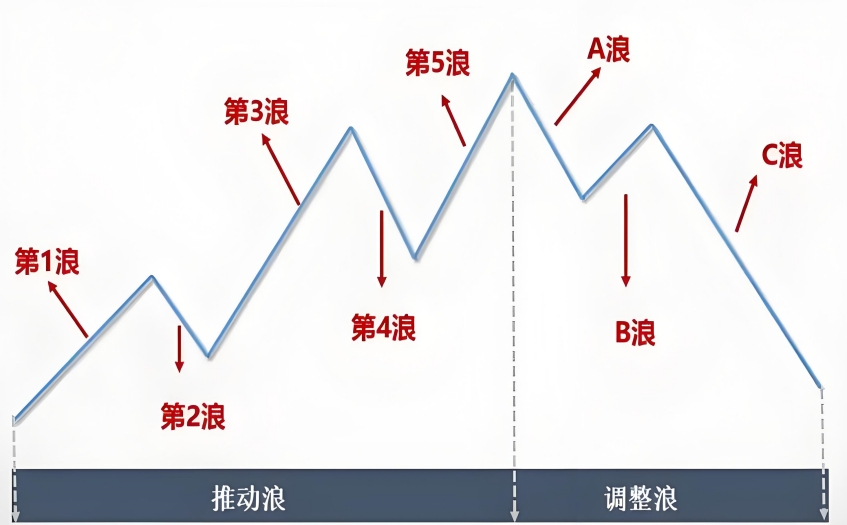
The wave theory, developed by Ralph Nelson Elliott in the 1930 s, argues that price movements in financial markets are made up of a series of fluctuations that take on a regular pattern. Wave theory divides market volatility into pushing waves (Impulse Waves) and adjusting waves (Corrective Waves).
2. Push the wave and adjust the wave.
(1) Push wave: The push wave consists of five waves, marked 1, 2, 3, 4, and 5. These five waves constitute the main trend of the market, where waves 1, 3, and 5 are rising waves (in an uptrend) and waves 2 and 4 are callback waves.
(2) Adjustment wave: The adjustment wave consists of three waves, marked A, B and C. These three waves constitute the secondary trend of the market, I .e. the adjustment to the main trend, where waves A and C are down waves (in an uptrend) and wave B is a rebound wave.
3. Wave period
According to the wave theory, market price fluctuations are cyclical and can be divided into several levels, from large to small, including: super cycle, primary cycle, secondary cycle, intraday cycle, etc. Each cycle is composed of smaller waves, forming a nested structure.
How 2. use wave theory to analyze the gold market.
1. Identify market trends
The first step of the wave theory is to identify the main trends in the gold market. By observing the historical trend of gold prices, determine whether the current trend is up or down. After identifying the main trends, the volatility pattern of the market can be further analyzed.
2. Mark the wave
Fluctuations in the price of gold are labeled as different waves according to the wave theory. First, find the five waves that push the wave, and then find the three waves that adjust the wave. Note the following when marking waves:
(1) Wave 3 cannot be the shortest pushing wave.
(2) Waves 2 and 4 cannot completely overlap.
(3) Wave 5 usually exceeds the end of wave 3.
3. Analyze the wave structure
After marking the waves, the structure of each wave is analyzed to confirm that it conforms to the wave theory pattern. The push wave usually shows a 5-3-5-3-5 structure, while the adjustment wave usually shows a 5-3-5 structure.
4. Predicting future trends
Predict the future movement of the gold price by analyzing the position and shape of the current wave. For example, if the market is currently in the third wave of the push wave, it can be expected that there will be fourth and fifth waves in the future. Similarly, if the market is currently in wave B of the adjustment wave, it can be expected that there will be a decline in wave C in the future.
5. Develop a trading strategy
According to the analysis results of wave theory, the corresponding trading strategy is formulated. For example, buy gold at the beginning of the first or third wave of the push wave and sell gold at the end of the fifth wave of the push wave; buy gold at the end of the or C wave of the adjustment wave and sell gold when the B wave rallies.
Examples of practical applications of 3. wave theory
1. Historical data analysis
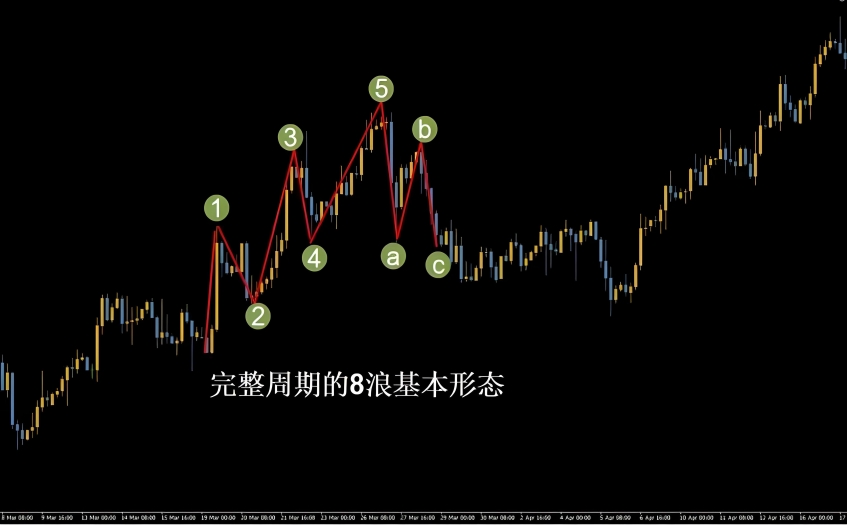
Assuming that the price of gold has shown a clear upward trend over the past period of time, the following waves can be marked by wave theory analysis:
(1) Wave 1: The first rise from the low.
(2) wave 2: wave 1 after the end of the callback.
(3) Wave 3: The second rise after the wave 2 pullback, usually the strongest rise.
(4) wave 4: wave 3 after the end of the callback again.
(5) Wave 5: The last rise after the wave 4 pullback.
2. Current Market Analysis
Assuming that the current price of gold is in the third wave of the driving wave, it can be expected that there will be a fourth wave of the market and a fifth wave of the rise in the future. In this case, investors can choose to buy gold at the end of the fourth wave's correction and wait for the fifth wave to rise to profit.
3. Risk management
When using wave theory to invest in gold, investors should pay attention to risk management. Set stop-loss points to avoid significant losses due to market fluctuations. At the same time, wave theory is a technical analysis tool, can not be used as a basis for trading decisions alone, should be combined with other analytical methods to judge the market trend.
Wave theory is an effective market analysis tool that can help investors identify volatility patterns and trends in the gold market and develop sound trading strategies. In the application of wave theory, investors need to have certain market analysis ability and experience, combined with other technical analysis methods, comprehensive judgment of market trends.